


Spring Pools Bring Salamander Jewels
/Ex-tree! Ex-tree! Read all about it! The biggest salamander event of the year is here, where our local slimy celebrities showcase their brilliance with their bright and colorful spring coats, to raise awareness for the vulnerability they face when it comes to habitat loss, pollution, other human disturbances, and much more. Right here in the dunes, residing under logs and other dampened ground cover in the Eastern Deciduous Forest, these slippery stars have slithered their way down the leaf-litter carpet for their annual Mander Gander Gala. And I, Campbelle Caudle, your very own educator here at the Dunes Learning Center, am hosting this event. We have a few stars that will certainly shine bright this evening.
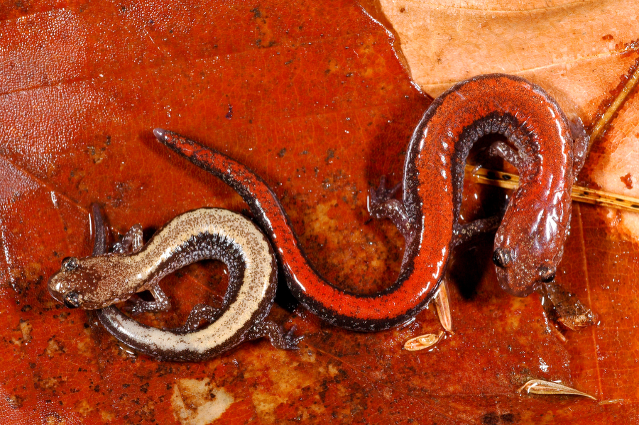
RED-BACKED SALAMANDERS (Plethodon cinereus) PHOTOGRAPHED BY DANIEL J. HOCKING.
The Red-Backed brothers make their stunning entrance, as they do every year, bringing with them very contrasting looks. Shadow, pictured on the left, brings with him a striking coat: mostly deep brown in base, with bright stars speckled on the sides and a prominent tan stripe running down his back. His brother, Blaze, pictured on the right, wears a coat with similar patterns, but tremendously different colors. The base of his coat is a much deeper color, almost black, and the stripe painted with the utmost remarkable red ever witnessed on this leaf-litter carpet. These soigné salamanders appear every year at the Mander Gander Gala, but spend most of their days in moist forests under luxury ground cover, such as fallen leaves or bark, logs, rocks, and even sometimes decaying root systems. The Red-Backed family doesn’t only consist of our two brothers here, but many slimy sisters and other relatives that can look fairly unrelated at times, having skins of varying brown tones with stripes that could be orange or yellow in color, or no stripes at all. Although the Red-Backed brothers reside here in the Indiana Dunes National Park, their relatives are spread all across the Northeastern United States, some bloodlines even spreading into Canada. On the other side of the midwestern states, though, we find more salamanders such as this madam…
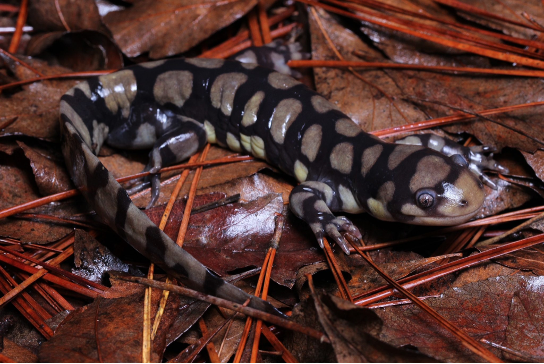
EASTERN TIGER SALAMANDER (Ambystoma tigrinum) PHOTOGRAPHED BY CJ HILLARD.
Introducing Tigris, she wears a stunning, sharp coat grounded in black, and spotted in fierce, tiger-like blotches. This unwieldy lady has striking eyes that could pierce right through your heart, with a face that has a much similar effect. Although her appearance may be intimidating, she is one of the more serene jewels you will find here tonight. Her calmness exceeds her, graciously exposing her golden heart. You are likely to find her browsing the Great Marsh in the Indiana Dunes, or sometimes in more wooded, sandy lands. In perceiving the lady’s pacific nature, unexpected but respectful guests seem to go without reprimand. She loves to entertain conversation, especially in the warmer and comforting months. Although carrying a social, adventurous spirit, she prefers spending her life deep in the dirt when it becomes the cold, bitter outside we all experience upon wintering times. Something the masses can all relate to. Speaking of the masses, here is another slippery star that everyone loves learning from…
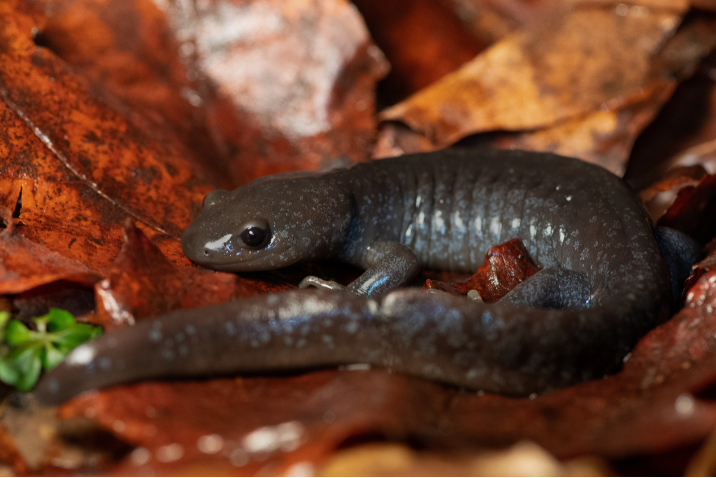
JEFFERSON SALAMANDER (Ambystoma jeffersonianum) PHOTOGRAPHED BY BRADY O’BRIAN.
Jeff Jefferson struts in (a fairly creative name, I might add). Although his look may seem a bit muted, there’s never a dull moment with this guy. This mysterious man brought with him a snazzy, taupe-colored suit, sleek and speckled in soothing pale blue. In the upland deciduous forests of the Indiana Dunes National Park, he spends most of his time underground in homey burrows, hunkering away unless provoked by hunger… or the spring season, when he likes to spend vacation days cooling off in a nearby pond. While laying in the spring’s pools, he’s fairly popular with the ladies, often surrounded by young maidens looking for company. Jeff already has a fairly large family, mostly consisting of females, one of which he brought with him: his cousin from the Blue-Spotted side of the family tree!
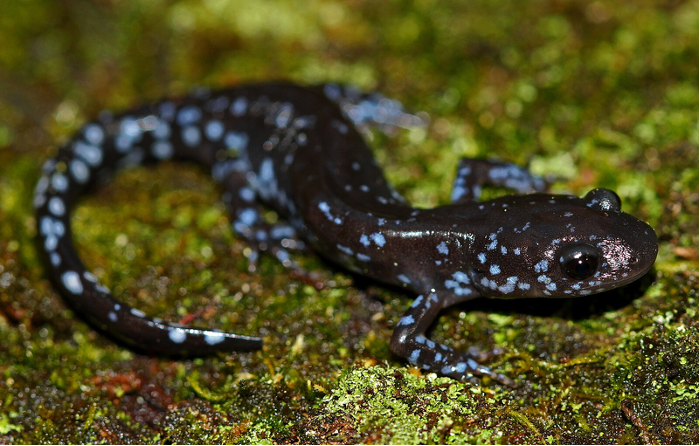
BLUE-SPOTTED SALAMANDER (Ambystoma laterale) PHOTOGRAPHED BY PETER PAPLANUS.
Well look who the cat dragged in: Oxford Blue. This full-time trouble-maker, part-time heart-breaker, is one bewildering young lad. These charming blue freckles cover his slim, black coating, climbing all over this astounding ensemble head-to-toe, and even crawling up onto his cheeks. He sure puts on a show. If this isn’t pompous confidence, I’m not sure what is. Much like his cousin, he spends a lot of time in pools laying out, enjoying the swaps of Northern Indiana. When not on the prowl for ladies, he can be found aboveground, slithering through the undersides of leafy logs and fallen forest leaves in hardwood areas and sandy woodlands. This guy might seem approachable with his well-known hunger for attention, but he has a temper like no-other. With any irritation that hops its way into the vicinity, his tail becomes slicked with an off-putting substance. This cerulean stud might hold onto his charms, but he also holds a temperament. Holding onto anger isn’t much of a desired quality, but many might say that having a sturdy, mossy home is.
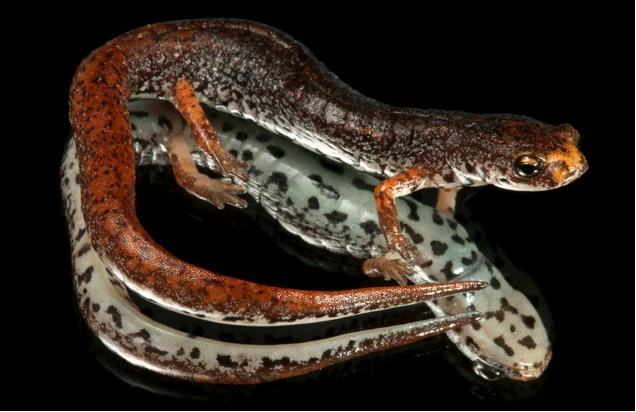
FOUR-TOED SALAMANDER (Hemidactylum scutatum) PHOTOGRAPHED BY INDOOR ECOSYSTEMS.
Speaking of, there’s Four-Toed Tom! He’s one of the only guests here tonight that owns a moss-studded residence, one of the more exquisite approaches to a salamander’s lifestyle. Though, we likely won’t see him here for long, as he’s known to “scut” out shortly after making these memorable, flashy appearances. This year, it seems he’s got a brown-based coat, speckled with red-orange bursts of color. But that’s not all, under this seemingly-striking coat is a much more impressive attire: a belly lathered in eggshell-white, mottled in these enticing, black splotches that expand head-to-four-toe. Four-Toed Tom is quite the special one- it’s in the name. He is the only jewel of the season to show up with four toes on all feet! Among the lands of the Indiana Dunes, Tom can be found roaming on land in the more wooded, boggy areas of the park, especially where there’s a mass of moss. With fellow four-toed companions sparse, he’s a bit of an involuntary loner. But at the Mander Gala, there is always, at the very least, momentary camaraderie.
And next we have… I cannot believe what I am seeing!
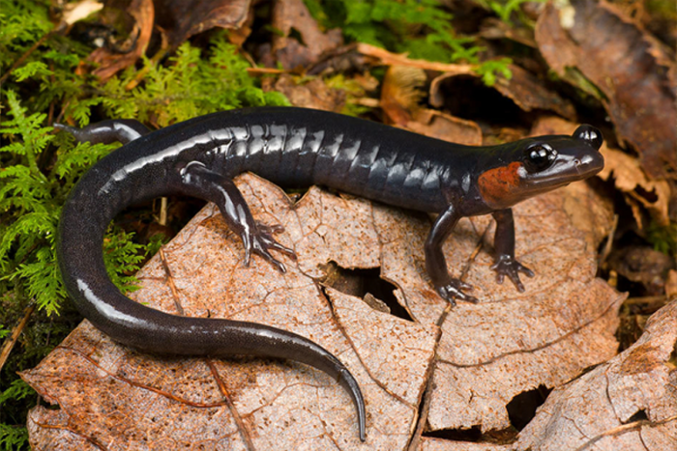
RED-CHEEKED SALAMANDER (Plethodon jordani) PHOTOGRAPHED BY KEVIN STOHLGREN.
All the way from the Great Smoky Mountains National Park (GSMNP) in Tennessee, is a sweet, southern surprise: jolly Jordan! You might ask, “what makes Jordan so jolly?” This young lady endlessly smiles wide with her big, bright twinkling eyes, and never fails to paint on her cheery-cherry cheeks. She’s put on quite a sleek look for the carpet tonight, bodied in a silky, smooth black dress. But don’t let her slim build and irresistible smile deter you, under all that jolly is a tough southern lady, and a defensive, gluey slime that can easily catch you in a mess. So long as you mean well, though, her gluey-goo sticks to herself.
We have seen a lot of special stars here tonight, most being from the captivating Indiana Dunes, and one from another far-away park: The Great Smoky Mountains. Down in Tennessee, there is an abundance of salamander jewels like no other, and that is what makes Miss Jordan so special: she could only be found there. And you could’ve found me there, too, before starting my fellowship here in the Indiana Dunes. Moving from Tennessee to Indiana has been a wild ride.
I’ve written this to commemorate my time as the DLC Nature Notes Blog editor, as well as my time spent in Tennessee, Indiana, and here: the Dunes Learning Center. What a joy it has been.
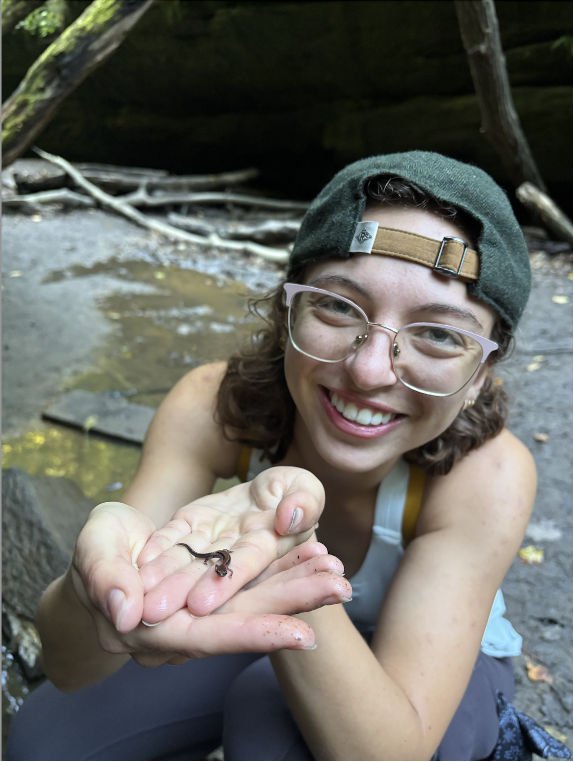
CAMPBELLE CAUDLE (First Year Environmental Educator) PHOTOGRAPHED BY MARIA SIGNORINO.


